How to Classify Cited URLs in Your Industry with Jev
Define a cited-URL taxonomy, encode it as typed Jev questions, validate it on labelled pages and route uncertain results to human review.
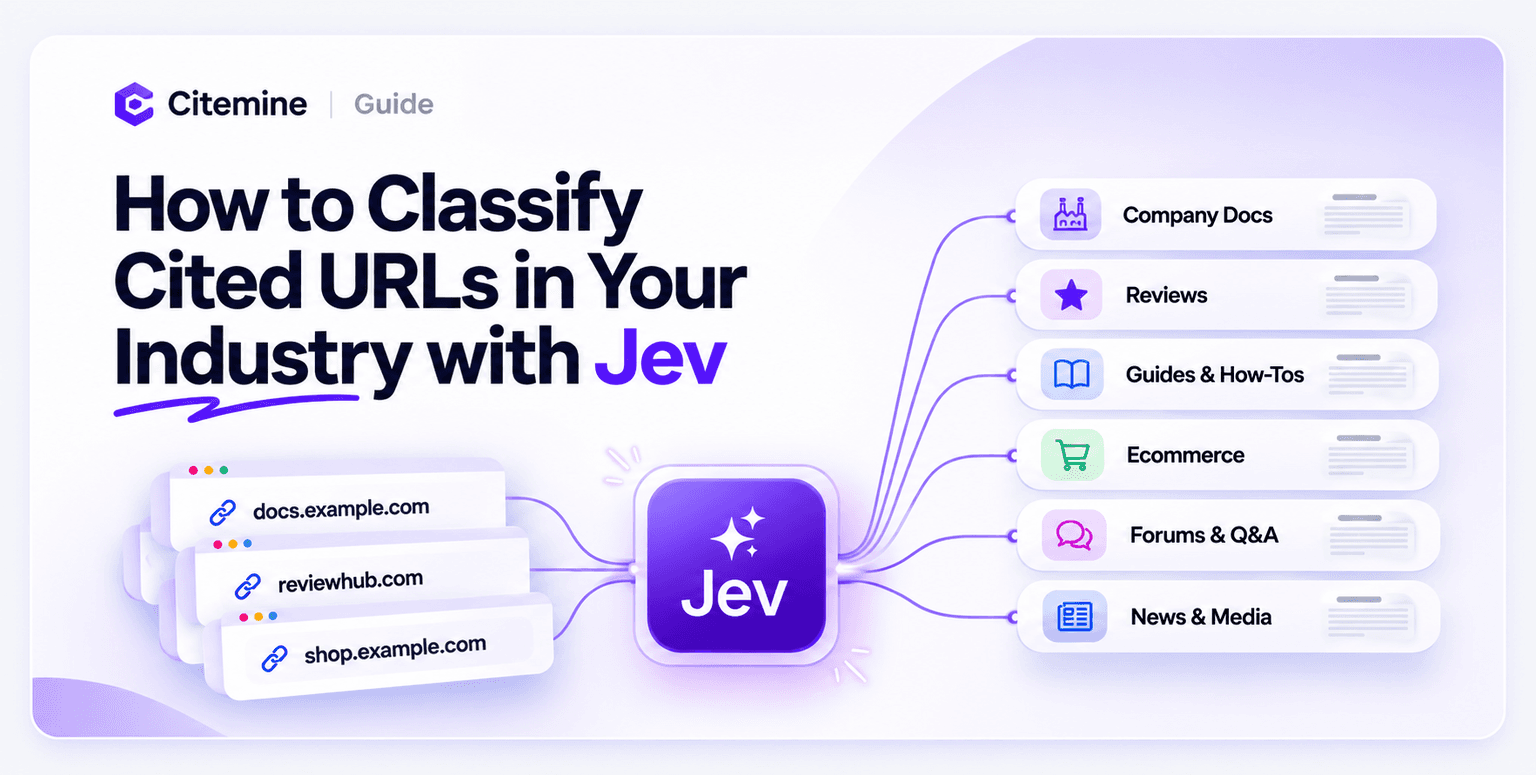
Classify cited URLs with Jev only after you define the taxonomy. Write one label list and set of decision rules for each independent question, test those rules on a human-labelled sample, and then encode them as Jev choice, score or noul questions. Jev returns typed labels, option probabilities and confidence, which makes it suitable for high-volume classification with an explicit review queue.
The useful unit is a page record with enough evidence to classify it: URL, domain, title, H1, page text or excerpt, structured-data type, publication details, prompt segment and supported claim. A URL string alone can identify some domains, but it cannot reliably distinguish an editorial comparison from a vendor’s own comparison page.
Why should the taxonomy come before Jev?
Jev chooses from the options you define. It cannot repair overlapping labels or decide which business question you meant to ask. If editorial, listicle, competitor and review platform sit in one list, the classes mix ownership, publisher model and page format. A competitor’s listicle could fit three options.
Use separate axes:
- Ownership: who controls the property?
- Publisher type: what kind of organization or surface published it?
- Page format: what kind of page is it?
- Primary intent: what job does the page perform for its reader?
- Actionability: what can the brand realistically do about this citation?
- Industry role: which vertical-specific role does the page play?
Each axis answers one question and returns one label. Multi-label output across axes comes from asking several typed questions in the same Jev request, not from forcing every combination into one giant list.
The first five axes transfer across industries. The sixth is where the taxonomy becomes useful for a specific market. Tourism needs to separate official properties, online travel agencies, review platforms, destination marketing organizations, transport operators and government advisories. A generic company label loses those differences.
What evidence should each page record contain?
Send the smallest state that supports the decisions. Jev charges by input tokens, and extra boilerplate can introduce noise.
{
  "observed_url": "https://example.com/best-payroll-tools",
  "canonical_url": "https://example.com/best-payroll-tools",
  "domain": "example.com",
  "title": "Best Payroll Tools for Distributed Teams",
  "h1": "The 12 Best Payroll Platforms for 2026",
  "excerpt": "We independently reviewed...",
  "schema_types": ["Article", "ItemList"],
  "author": "Jane Smith",
  "organization": "Example Media",
  "prompt_segment": "commercial_comparison",
  "supported_claim": "Product A supports contractor payments in 120 countries",
  "known_brand_domains": ["client.com"],
  "known_competitor_domains": ["competitor.com"]
}
Keep known brand and competitor domains outside probabilistic classification where possible. Exact domain rules are cheaper and more reliable for ownership. Use Jev for the ambiguous remainder and for content-dependent axes.
Which ownership labels should you define?
Ownership determines whether the page is a first-party asset, competitor evidence or an independent source.
| Label | Definition | Include | Exclude |
|---|---|---|---|
owned |
Property controlled by the focal brand | Main domain, official subdomains, brand-owned newsroom or docs | Independent profiles and distributors |
competitor_owned |
Property controlled by a named direct competitor | Competitor product site, docs, blog or research hub | Independent article mentioning competitors |
third_party |
Property controlled by neither the focal brand nor a defined competitor | Publishers, communities, review sites, government and academia | Syndicated page owned by the focal brand |
mixed_or_unclear |
Ownership cannot be determined from supplied evidence | Joint ventures, unclear white-label sites, ambiguous subsidiaries | A known domain that a rule can resolve |
Apply an exact domain map first. If a parent company owns several product domains, document the relationship in the map. Do not infer ownership from whether the brand appears in the article.
Which publisher-type labels should you define?
Publisher type describes the surface, independent of the page’s format.
| Label | Definition | Typical evidence |
|---|---|---|
company |
A commercial organization publishing on its own property | Product company, agency, retailer, vendor blog |
editorial_media |
A publication with an editorial publishing model | Newsroom, magazine, trade publication |
community_forum |
User-created discussion and answer surface | Reddit, Quora, Stack Exchange, specialist forum |
review_marketplace |
Platform structured around listings, reviews or product comparison | G2, Capterra, Trustpilot, marketplace category pages |
reference |
General reference or encyclopedic source | Wikipedia, dictionary, standards explainer |
academic_research |
University, journal, conference or research repository | Paper, lab page, institutional study |
government_public_body |
Government, regulator or public institution | .gov page, regulator guidance, public dataset |
social_video |
Social network or video publishing surface | YouTube, LinkedIn post, TikTok |
other_or_unclear |
No defensible match from supplied evidence | Unknown aggregators or thin republishers |
A company blog is company even when the article has an editorial tone. A review article on a newspaper site remains editorial_media; its page format can be comparison_roundup.
Which page-format labels should you define?
Page format captures the document’s structure and expected evidence type.
| Label | Definition | Positive cues |
|---|---|---|
product_or_service |
Describes one offering and its features or value | Product schema, pricing CTA, feature sections |
category_or_listing |
Lists entities without substantial comparative evaluation | Directory, category archive, marketplace list |
comparison_roundup |
Compares two or more named options using criteria | “Best,” “top,” “versus,” ranked list, comparison table |
review |
Evaluates one named product, service or organization | Rating, pros/cons, test method, verdict |
how_to |
Gives ordered instructions to complete a task | Steps, prerequisites, procedure |
explainer_definition |
Defines or explains a concept | “What is,” glossary, conceptual guide |
research_data |
Presents original or compiled data with method | Sample, methodology, results, dataset |
news_announcement |
Reports a time-bound event or release | Dateline, event, launch, acquisition, policy change |
documentation_support |
Provides official technical or operational instructions | API docs, help center, troubleshooting |
discussion_thread |
Contains a user-led conversation or answers | Posts, replies, votes, accepted answer |
profile_entity |
Represents one organization, person, product or location | Directory profile, knowledge panel page |
other_or_unclear |
Evidence does not support one primary format | Mixed or inaccessible page |
Choose the primary format. Store secondary traits such as has_table, has_original_data and has_step_list as separate yes/no fields. Otherwise, the label list expands until the classes become impossible to apply consistently.
Which intent labels should you define?
Intent describes the page’s primary reader job, not the prompt that produced the citation.
| Label | Definition | Example job |
|---|---|---|
informational |
Learn a concept, fact or process | Understand payroll compliance |
commercial_investigation |
Compare options before a decision | Select payroll software |
transactional |
Complete a purchase, signup, download or booking | Start a trial |
navigational |
Reach a known entity or resource | Find official API documentation |
mixed |
Two intents are equally necessary to the page | Detailed comparison with direct purchase flow |
unclear |
The supplied evidence does not support a decision | Blocked or empty page |
Mixed intent should be rare. Define it as a genuine tie, not a fallback for uncertainty; unclear handles insufficient evidence.
Which actionability labels should you define?
Actionability converts classification into a work queue. It depends on the focal brand, so supply brand context in the state.
| Label | Definition | Default action |
|---|---|---|
optimize_owned |
The brand controls the cited page | Improve accuracy, passage structure, freshness and internal links |
close_content_gap |
A competitor-owned page answers a topic the brand does not cover well | Build or revise first-party content |
editorial_outreach |
An independent publisher could add evidence, correction or inclusion | Prepare a specific, evidence-led pitch |
profile_or_review_ops |
A listing/review surface can be improved through legitimate profile and review work | Complete profile and improve review operations |
community_participation |
A community source is influenceable only through genuine participation | Contribute within community rules |
reference_alignment |
The source is difficult to influence but defines accepted facts or standards | Align claims and cite the source where appropriate |
monitor_only |
No ethical or realistic intervention is available | Track changes; do not spend outreach time |
manual_review |
Evidence or policy risk prevents automatic routing | Analyst decides |
Actionability is a recommendation class, not an objective property of the URL. A government page may be reference_alignment for one project and monitor_only for another.
Which tourism-specific source roles should you define?
Add tourism_source_role when the cited-URL set covers hotels, destinations or travel planning. Classify the page’s role in the traveller’s decision, not the legal form of its owner.
| Label | Definition | Include | Exclude |
|---|---|---|---|
official_property |
First-party page for one hotel, resort, attraction or tour product | Hotel overview, room page, official attraction page | OTA listing for that property |
ota_booking_platform |
Intermediary that searches, compares or books inventory from multiple suppliers | Booking.com, Expedia and Hotels.com destination/property pages | A hotel’s own booking engine |
review_platform |
Platform where ratings and traveller reviews are central evidence | Tripadvisor destination or property review page | A discussion forum hosted on the same domain |
destination_marketing_organization |
Official or delegated body promoting a place | National tourism board, city CVB, regional DMO | Government safety advisory |
travel_editorial |
Publisher producing independent destination advice or travel journalism | Lonely Planet destination guide, travel magazine | DMO guide or OTA landing page |
traveller_community |
User-led travel discussion, question or experience thread | Reddit thread, Tripadvisor forum topic | Tripadvisor destination landing page |
government_advisory |
Public authority publishing entry, safety, health or regulatory guidance | Foreign ministry advisory, visa authority, public-health notice | Promotional tourism-board content |
transport_operator |
Airline, rail, ferry, airport or local transport operator publishing route/service information | Airline stopover guide, rail timetable, airport transfer page | General travel publisher discussing transport |
research_reference |
Statistical, academic, library or standards source used for evidence | Tourism dataset, academic paper, Library of Congress research guide | Commercial blog quoting statistics |
social_video_creator |
Social or video page where the creator and media are the source | YouTube itinerary, Instagram guide | Embedded video on an official hotel page |
other_or_unclear |
No role can be assigned from the supplied page evidence | Blocked, thin or ambiguous page | A page that matches a defined role |
Domain rules can suggest a role, but they cannot finish the classification. Tripadvisor hosts review pages and traveller forums. A page-level classifier should label the destination page review_platform and a forum topic traveller_community even though both URLs share tripadvisor.com.
How does the taxonomy work on a tourism validation set?
The table below uses public Istanbul and travel pages extracted on 11 October 2026. It tests the taxonomy; it is not a claim that an answer engine cited these pages. A real benchmark must start from URLs observed in saved LLM answers.
| Page | Publisher type | Page format | Intent | Tourism role | Likely actionability |
|---|---|---|---|---|---|
| GoTürkiye | government_public_body or other_or_unclear pending ownership rule |
category_or_listing |
informational |
destination_marketing_organization |
reference_alignment |
| Booking.com Istanbul hotels | review_marketplace |
category_or_listing |
transactional |
ota_booking_platform |
profile_or_review_ops |
| Tripadvisor Istanbul destination page | review_marketplace |
category_or_listing |
commercial_investigation |
review_platform |
profile_or_review_ops |
| Tripadvisor Booking.com ban forum topic | community_forum |
discussion_thread |
informational |
traveller_community |
community_participation |
| Lonely Planet Istanbul | editorial_media |
explainer_definition |
commercial_investigation |
travel_editorial |
editorial_outreach or monitor_only |
| Government of Canada travel advisories | government_public_body |
category_or_listing |
informational |
government_advisory |
reference_alignment |
| Library of Congress tourism research guide | government_public_body |
explainer_definition |
informational |
research_reference |
reference_alignment |
Two rows should trigger manual review during taxonomy development. GoTürkiye’s ownership and operating structure must come from a maintained organization map rather than page tone. Lonely Planet may be reachable for editorial work in one campaign and unrealistic in another, so actionability needs client and market context.
Tavily could extract seven of nine selected pages. The St. Regis Istanbul and Turkish Airlines Touristanbul pages failed in the basic extraction attempt. Keep these failures in the dataset, label their content evidence as missing and route them to refetch or manual review. Dropping blocked pages would make the classifier test easier while hiding a common production condition.
The tourism role can be encoded as another choice question:
{
  "tourism_source_role": {
    "type": "choice",
    "instructions": "Classify the role this page plays in a traveller's decision. Classify the page, not the domain. Use other_or_unclear when content evidence is missing.",
    "criteria": {
      "official_property": "First-party page for one hotel, resort, attraction, or tour product",
      "ota_booking_platform": "Intermediary comparing or booking inventory from multiple suppliers",
      "review_platform": "Page where ratings and traveller reviews are central evidence",
      "destination_marketing_organization": "Official or delegated body promoting a destination",
      "travel_editorial": "Independent destination advice or travel journalism",
      "traveller_community": "User-led travel discussion, question, or experience thread",
      "government_advisory": "Public safety, entry, health, visa, or regulatory guidance",
      "transport_operator": "Airline, rail, ferry, airport, or local transport service page",
      "research_reference": "Statistical, academic, library, or standards evidence",
      "social_video_creator": "Social or video creator page used as the source",
      "other_or_unclear": "No defensible role from the supplied evidence"
    }
  }
}
Which tourism prompts should seed the real cited-URL set?
Use one destination and one accommodation segment for the pilot. An Istanbul hotel set can cover the main source roles without mixing unrelated countries.
| Segment | Example prompt |
|---|---|
| Destination discovery | What are the best areas to stay in Istanbul for a first visit? |
| Accommodation comparison | Which Istanbul hotels are best for families near Sultanahmet? |
| Property comparison | Hotel A vs Hotel B for a three-night Istanbul city break |
| Transport | What is the easiest way to travel from Istanbul Airport to Sultanahmet? |
| Safety | Is Istanbul safe for a solo traveller at night? |
| Regulation | What entry requirements apply to a UK traveller visiting Türkiye? |
| Experience | Which Bosphorus cruise is suitable for a family with children? |
| Accessibility | Which central Istanbul hotels have step-free rooms and transport access? |
| Budget | Where should a couple stay in Istanbul under €150 per night? |
| Seasonal | Where should I stay in Istanbul during Ramadan or New Year? |
Freeze the traveller origin, dates, currency and party type where they affect the answer. Run the same prompt set across the selected engines and at least three repetitions before treating the resulting URL set as the Jev input corpus.
Which auxiliary gates should you add?
Use Jev noul questions for calibrated yes/no gates and score for ordered assessments.
needs_human_review: conflicting evidence, inaccessible content, ambiguous ownership or policy risk.brand_present: the focal brand appears in the extracted page content.competitor_present: a defined competitor appears.supports_claim: the page supports the answer claim attached to the citation.outreach_safety: ordered scale from prohibited/unsafe to normal editorial contact.evidence_quality: ordered scale based on sourcing, method and specificity.
Do not use a confidence score as proof that the label is correct. Confidence shows how concentrated the model’s option distribution is. Validate thresholds against your own labelled sample.
How do you encode the taxonomy as Jev questions?
Jev accepts a state plus a map of typed questions. A choice question can define up to 255 options and returns one option with probabilities and confidence. Multiple questions run in one request and share the state.
{
  "model": "jev-1.13.0",
  "state": {
    "url": "https://example.com/best-payroll-tools",
    "domain": "example.com",
    "title": "Best Payroll Tools for Distributed Teams",
    "h1": "The 12 Best Payroll Platforms for 2026",
    "excerpt": "We independently reviewed each platform using...",
    "prompt_segment": "commercial_comparison",
    "supported_claim": "Product A supports contractor payments in 120 countries"
  },
  "questions": {
    "publisher_type": {
      "type": "choice",
      "instructions": "Classify who publishes this page. Use other_or_unclear when the evidence is insufficient.",
      "criteria": {
        "company": "Commercial organization publishing on its own property",
        "editorial_media": "News, magazine, or trade publication with an editorial model",
        "community_forum": "User-created discussion or answer community",
        "review_marketplace": "Listings, reviews, or product-comparison platform",
        "reference": "Encyclopedic or general reference source",
        "academic_research": "University, journal, conference, or research repository",
        "government_public_body": "Government, regulator, or public institution",
        "social_video": "Social network or video publishing surface",
        "other_or_unclear": "No defensible match from the evidence"
      }
    },
    "page_format": {
      "type": "choice",
      "instructions": "Choose the page's primary document format, not its publisher type.",
      "criteria": {
        "product_or_service": "One offering, its features, pricing, or value",
        "category_or_listing": "A list or directory without substantial evaluation",
        "comparison_roundup": "Two or more options compared using criteria",
        "review": "Evaluation of one named product, service, or organization",
        "how_to": "Ordered instructions for completing a task",
        "explainer_definition": "Definition or conceptual explanation",
        "research_data": "Data or findings with a stated method",
        "news_announcement": "Time-bound event, release, or announcement",
        "documentation_support": "Official documentation, help, or troubleshooting",
        "discussion_thread": "User-led posts, replies, or answers",
        "profile_entity": "Profile for one entity, product, person, or location",
        "other_or_unclear": "No defensible primary format"
      }
    },
    "intent": {
      "type": "choice",
      "instructions": "Classify the page's primary reader job.",
      "criteria": {
        "informational": "Learn a concept, fact, or process",
        "commercial_investigation": "Compare options before a decision",
        "transactional": "Complete a purchase, signup, download, or booking",
        "navigational": "Reach a known entity or resource",
        "mixed": "Two intents are equally central",
        "unclear": "Insufficient evidence"
      }
    },
    "tourism_source_role": {
      "type": "choice",
      "instructions": "Classify the role this page plays in a traveller's decision. Classify the page, not the domain.",
      "criteria": {
        "official_property": "First-party hotel, resort, attraction, or tour-product page",
        "ota_booking_platform": "Multi-supplier search, comparison, or booking intermediary",
        "review_platform": "Ratings and traveller reviews are central evidence",
        "destination_marketing_organization": "Official or delegated destination promotion body",
        "travel_editorial": "Independent destination advice or travel journalism",
        "traveller_community": "User-led travel discussion or experience thread",
        "government_advisory": "Public safety, entry, health, visa, or regulatory guidance",
        "transport_operator": "Airline, rail, ferry, airport, or local transport operator",
        "research_reference": "Statistical, academic, library, or standards source",
        "social_video_creator": "Social or video creator page",
        "other_or_unclear": "Insufficient evidence or no defined role"
      }
    },
    "needs_human_review": {
      "type": "noul",
      "instructions": "Does ambiguity, missing content, conflicting evidence, or policy risk require human review?"
    }
  }
}
Pin the Jev version after you tune thresholds. A moving jev-latest target can change label distributions even when your inputs and taxonomy remain fixed.
Should every field be classified by Jev?
Use deterministic rules where the answer is already known.
| Decision | Preferred method |
|---|---|
| Known owned or competitor domain | Exact domain map |
| URL normalization and redirect resolution | Code |
| Publisher and page format from text | Jev |
| Brand or competitor mention | Exact entity matching, then Jev for ambiguous names |
| Claim support | Passage matching plus Jev noul, with review for high-value cases |
| Final outreach action | Rules over taxonomy labels, with Jev for ambiguous routing |
This hybrid design gives you an audit trail. A reviewer can see whether a label came from a domain rule, Jev decision or manual override.
How do you build the human-labelled test set?
Sample pages before running the full inventory. Include common classes, rare classes and hard boundary cases.
- Draw a stratified sample across engines, prompt segments and high-frequency domains.
- Have two people label at least the ambiguous subset independently.
- Record disagreements and revise definitions before measuring Jev.
- Freeze a held-out test set that will not be used to tune instructions or thresholds.
- Keep
unclearandmanual_reviewexamples in the test set; deleting them creates a misleadingly easy benchmark.
Start with enough examples to expose definition failures. A small pilot of 100–200 pages can reveal overlapping labels, but it does not establish production accuracy for rare classes. Expand the sample until every class that drives an action has a meaningful test count.
Which metrics should you report?
Overall accuracy hides failure on small but valuable classes. Report:
- confusion matrix for every axis;
- per-class precision, recall and F1;
- macro-F1 so large classes do not dominate the score;
- coverage at each confidence threshold;
- error rate after human-review routing;
- manual-review volume and minutes per 100 pages;
- label distribution by engine and prompt segment;
- cost and latency per page.
Set thresholds by consequence. A false editorial_outreach label wastes analyst time. A false monitor_only label can bury a valuable opportunity. Those classes may need different automation thresholds.
How should confidence-gated routing work?
Use a three-lane queue after validation:
- Auto-accept: label and all rule checks meet a tested threshold.
- Human review: confidence falls below the threshold, two axes conflict, or
needs_human_reviewcrosses its gate. - Reject and refetch: page content is empty, blocked, stale or mismatched to the URL.
Store the full probability distribution, resolved model version, taxonomy version and final reviewer decision. These fields let you recalibrate thresholds and find drift later.
How do the labels become SEO and GEO work?
Join the classified page table back to prompts and citation events.
owned + how_to + informationalshows which first-party procedures already earn citations.competitor_owned + explainer_definitionreveals first-party content gaps.third_party + editorial_media + comparison_roundupforms an evidence-led outreach pool.third_party + review_marketplace + commercial_investigationpoints to profile and review operations.third_party + community_forum + discussion_threadshows where real category conversations shape answers.government_public_body + research_dataidentifies standards and data the brand should align with.
Calculate the distribution by engine and prompt segment. A source mix averaged across every prompt can hide that commercial questions depend on review platforms while technical questions depend on documentation.
What should you publish with the results?
Publish the taxonomy version, definitions, sample construction, model version, thresholds, confusion matrices and manual-review policy. Keep client-sensitive URLs private if necessary, but expose enough method for another practitioner to evaluate the claims.
Do not publish a source-type percentage without naming the classification unit. State whether the denominator is citation events, unique pages, unique domains, answers or prompts. Re-run a labelled audit when the taxonomy, extractor or pinned Jev version changes.
Is your business in the answer?
One report, four AI platforms, the questions your customers actually ask.